

WIUNIX / HOW WE WORK
A clear scope. A result you can verify.
Understand the system, make decisions explicit and deliver changes the operating team can own.
PROPORTIONATE TO THE RISK
Small tasks need focus. Critical changes need safeguards.
A bounded correction should not become a lengthy architecture exercise. A migration affecting a critical service needs deeper discovery, a controlled change window and a workable recovery plan. We scale review, testing and handover to the consequence of failure.
Before implementation
Agree the affected service, intended behavior, constraints, responsible roles and acceptance checks. Record assumptions and missing information so they can be resolved rather than silently becoming design decisions.
Keep production protected: pilots, staged changes, rollback and independent checks are selected where the risk calls for them. Critical systems are not a place for unsupported experimentation.
SIX STAGES, USEFUL OUTPUTS
Each decision prepares the next piece of work.
The stages describe a delivery path, not six mandatory meetings. Their depth and sequence follow the engagement; discovery and assessment may be brief for a well-understood task and iterative for a complex environment.
Discover
Inspect the current behavior, dependencies and operating constraints. Identify who owns the system and which information is still missing.
A shared current-state record.
Assess
Separate observed problems from assumptions. Prioritize risks and determine which changes are useful within the available access, time and responsibilities.
Priorities and explicit unknowns.
Architect
Describe the target behavior, interfaces and boundaries. Record the important choices, dependencies and reasons for selecting the proposed approach.
A design and acceptance basis.
Build / Migrate
Implement in bounded steps. For risky changes, agree prerequisites, change timing, rollback triggers and the person authorized to proceed or stop.
Implementation artifacts and a change record.
Accept
Check the intended behavior against the agreed scope. Record test results, residual risks and unresolved items; a successful installation alone is not acceptance.
Verification evidence and a delivery decision.
Operate / Optimize
Transfer operating knowledge, update runbooks and monitoring references, and prioritize follow-up work. Ongoing support requires an explicit agreed responsibility.
Named ownership and a practical next-work list.
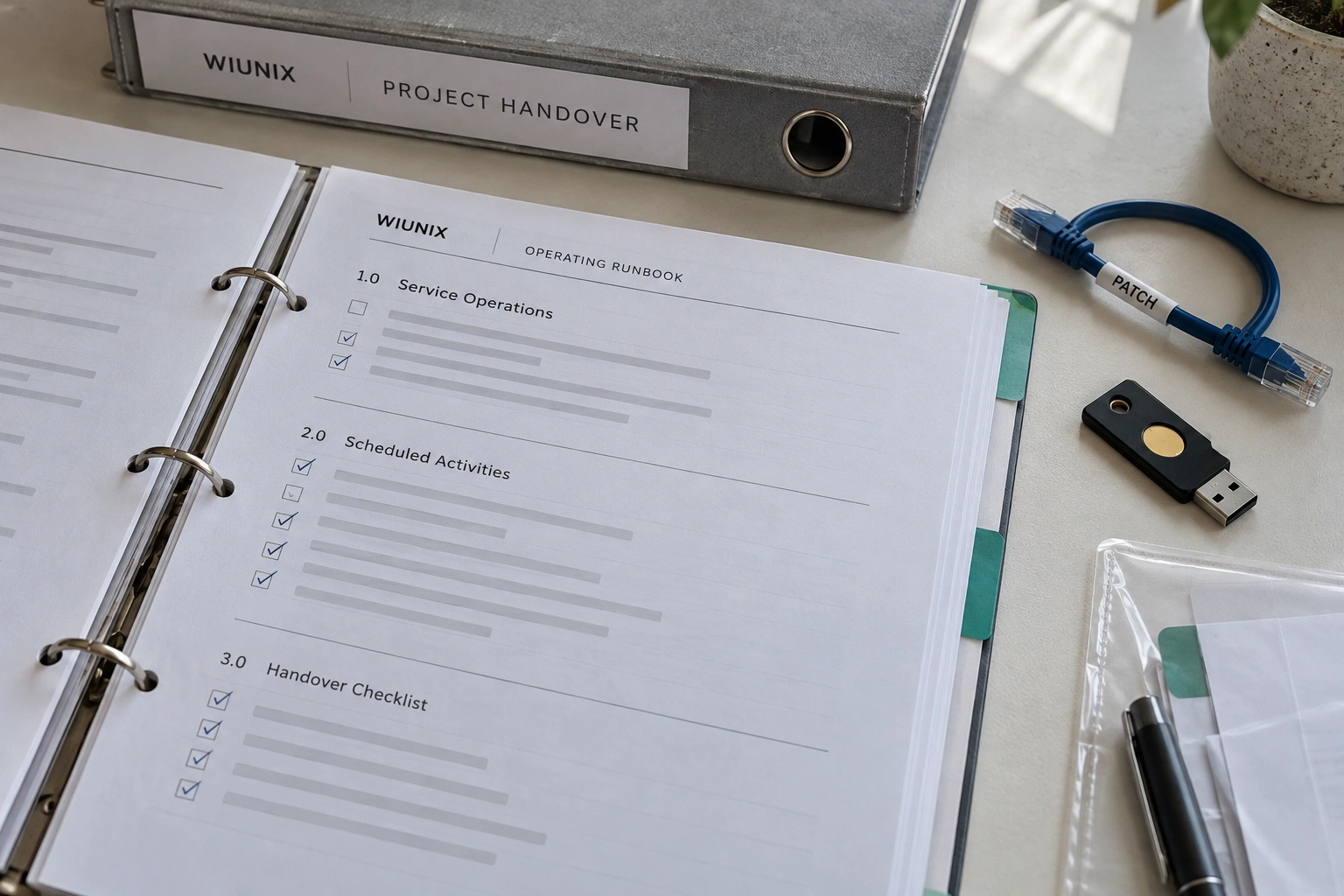
Illustrative handover materials, not a customer record or a verified operating procedure.
A RESULT THE TEAM CAN USE
Leave more than a working change.
The agreed handover connects architecture decisions, implementation artifacts and verification results to operating instructions. The team should be able to locate what changed, understand how it was checked and know who handles the next incident or improvement.
The definition of done
- Target behavior verified within the agreed scope.
- Residual risks and unresolved items are visible.
- Operational ownership and recovery instructions are clear.
- Follow-up improvements have an agreed priority.
The document set and support boundary depend on the engagement. This page does not create a standard SLA, guaranteed recovery time or blanket support coverage.
A PRACTICAL EXAMPLE
Moving a service without losing its operating context.
For a planned service migration, begin with the existing dependencies and owner roles. Agree target behavior and checks, prepare the change and recovery path, then test the relevant application and integration behavior after the move. Record remaining issues and transfer the operating references. This is an illustrative approach, not a customer case study or a promise of uninterrupted migration.
Start the discussion with context
Share the service, current problem, proposed change, responsible team and time constraints at a high level. Keep passwords, keys, personal records and sensitive configuration out of the public form; technical access is arranged separately.
Explore engineering services →Cloud Modernization →Operational Resilience →