WIUNIX AEGIS + AGENT
Cyber protection. From endpoint to enterprise.
Wiunix Aegis connects endpoint, web, API and cloud security. Wiunix Agent brings device evidence into one workspace for investigation and controlled response.
ONE SECURITY FABRIC
One connected security picture.
Connect device, identity, application and cloud evidence so your team can understand risk and coordinate a response.
Prevent
Endpoint controls · WAF · application policy
Understand
Assets · identities · exposure · threat context
WIUNIX
AEGIS
Shared context Governed decisions
Investigate
Telemetry · hunting · detections · incidents
Respond
Playbooks · containment · evidence · recovery
WIUNIX AGENT
Protection starts on the device.
One modular runtime for Windows, Linux and macOS, with separate permissions and policies for security collection, protection and response.

Windows
Linux
macOS
1
Device identity
Revocable device identities, protected keys and encrypted transport.
2
Security collection
Scoped inventory, process, network, log and file-integrity observations.
3
Local continuity
Encrypted queues and last-known-good policy keep interruptions visible and bounded.
4
Fleet lifecycle
Enrollment, groups, signed staged updates and rollback, with per-device history.
Endpoint protection & deployment details
Endpoint prevention and change control
Malware scanning, quarantine, file and website integrity, and behavioral detection for suspicious processes, scripts, credential abuse and ransomware. Publisher/signature/hash policies, firewall controls and isolation apply only within authorized scope.
Hardening, vulnerability and platform posture
Review configuration, package exposure, rootkit/tamper signals and exploit-mitigation posture. Plan changes with versioned baselines, exceptions, dry runs and maintenance windows; keep stopped sensors and stale inventory visible.
A shared Agent, independently controlled modules
Aegis security, Observe operations and Backup jobs retain separate policies, queues, permissions and destinations. Desktop and headless operation share protected keys, revocation, signed updates and recovery controls.
WEB, API & NETWORK PROTECTION
Protect the request path.
A policy-owned gateway combines OWASP CRS inspection, detect/block modes, virtual patches and scoped exceptions with your investigation workflow.

Applications and APIs
Inspect requests and uploads, discover API exposure and tune schema, rate and authorization controls per site or route.
Internet-facing services
Review TLS and exposed services; address bots, credential attacks and Layer 7 availability, with upstream DDoS integration.
Network context
Connect IDS/IPS, DNS, host firewall and lateral-movement signals to the same assets and incidents.
IN
Site / API
↓
→
POLICY
Policy & WAF
↓
→
OUT
Application
Web-server and hosting integration: Nginx · Apache · LiteSpeed · IIS · cPanel · Plesk · DirectAdmin
THE SECURITY OPERATIONS WORKSPACE
From alert to investigation.
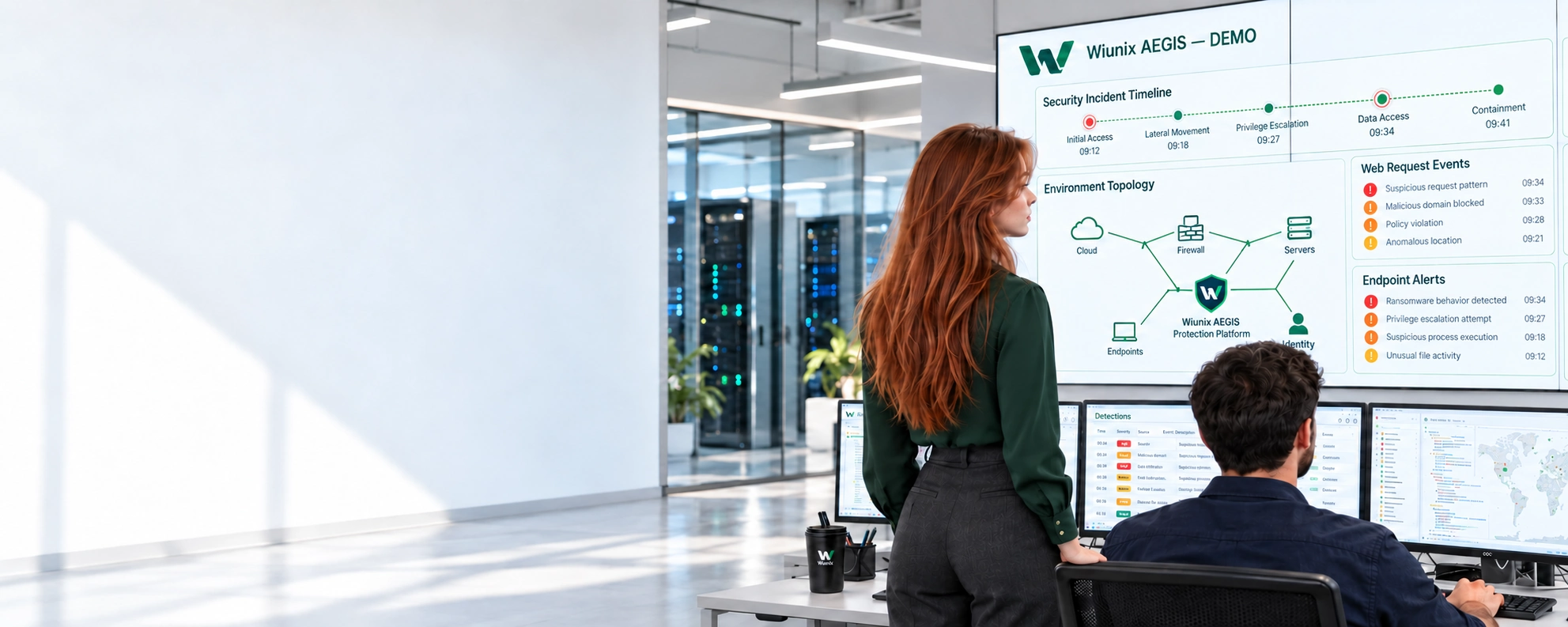
Connect normalized telemetry, Sigma detections and threat intelligence across devices, identities and applications. Keep evidence and response decisions together.
1
Observe the signal
Start with an unusual login, process or listener; retain its time, source and asset.
2
Find the relationship
Hunt across devices, identities and findings without losing the original evidence.
3
Own the incident
Create a case, assign an owner and keep decisions, attachments and custody attributable.
4
Act and verify
Review targets and approvals, then reconcile execution receipts. Delivery, acknowledgement and completed action remain distinct.

Investigation controls & evidence
Hunting and evidence
Search normalized events, retain raw evidence and hashes, and export authorized investigation packages.
Detection engineering
Version rules and correlation windows; test benign cases, indicator provenance, expiry and controlled detection exercises.
Response orchestration
Allow-listed, signed, time-limited commands retain role separation, approval, replay protection, audit and rollback.
EXPOSURE & SOFTWARE SECURITY
Find risk. Own the fix.
Prioritize host, application and software findings by business impact and exploitability. Keep ownership, exceptions and retest evidence visible.
Surface
Assess
Resolve
Surface
Hosts and images
Assess
Package/image vulnerabilities, EOL, feed freshness and KEV/EPSS context.
Resolve
Owned patch campaigns, maintenance windows, staged rollout and rescan.
Surface
Code and dependencies
Assess
SBOM, dependencies, licenses, VEX, SAST and infrastructure-as-code findings.
Resolve
Developer references, deduplication, tickets, expiring exceptions and verified fixes.
Surface
Web and external exposure
Assess
Authenticated DAST, exposed services, TLS and API authorization.
Resolve
Authorized scope, test budgets, reproducible evidence, virtual patches and retest.
Surface
Secrets and trust
Assess
Masked secrets, signing, artifact provenance and update integrity.
Resolve
Owner-led revocation or rotation, scoped notices and replacement evidence.
BEYOND THE ENDPOINT
Cloud, identity and data. Connected.
Cloud & workloads
AWS, Azure and GCP posture; permissions, containers and Kubernetes findings linked to workload identity.
Identity & collaboration
Risky authentication, OAuth and privileged accounts, plus email, phishing, attachment and domain-authentication posture.
Sensitive data
Scoped discovery, classification, masking and DLP, with egress controls, retention, deletion and evidence holds.
Specialist environments
SaaS sharing, passive OT/IoT visibility, mobile/MDM integration and AI tool, prompt-injection and exfiltration risks.
Each finding keeps its asset owner and source context across integrations.
RESPONSE & RECOVERY
Contain. Recover. Verify.
Connect approved containment, forensic evidence, credential recovery and clean restoration in one accountable workflow.

RESPONSE PLAYBOOK
- Contain — Apply approved isolation or blocking while preserving management and recovery paths.
- Preserve — Retain scoped triage evidence, hashes, custody and approval records.
- Recover — Check Wiunix Backup integrity, test isolated restoration and validate the service.
- Learn — Refine detections, track residual risk and exercise the response plan.
Use RPO/RTO goals, backup integrity, isolated restore tests and dependency checks before returning a service to operation.
BUILT FOR ORGANIZATIONAL CONTROL
Built around your organization.
Organization and delegated operations
Wiunix ID sign-in, scoped organizations and viewer, analyst, responder and admin roles, without mixing customer evidence.
Governance and evidence
Named owners, versioned policies, separate approvals and expiring exceptions, with traceable control evidence and exports.
Data and platform operations
Separate records, event analytics and forensic storage; manage retention, tenant budgets, connector health and offline updates.
People and daily use
English and Persian workspaces, PWA access, durable notifications and escalation preferences, supported by runbooks and training.
Define collection, prevention and response around your assets, priorities and operating requirements.